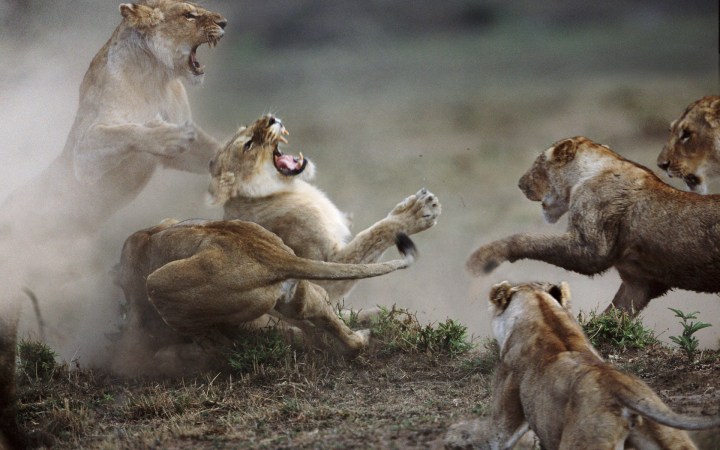
In the current, desperate political climate of Brexit, Boris, Corbyn, and Trump, it seems as good a time as any to be learning about political obligation. Why do we give complete strangers such control over our lives, and what would happen if the whole system came crashing down? What are the differences between the Platonic ideas of bad government, and the theories of Hobbes?
In Leviathan, Thomas Hobbes begins his theory of why it is in man’s best interest to be governed by an all-powerful sovereign by describing the state of nature: a state in which no sovereign power or entity exists and all men are free and equal. Hobbes’ definitions of freedom and equality, however, differ somewhat from our late 20th century, democratically-inspired visions.
Hobbes’ state of nature is actually a state of war, where men are free to attack one another in line with their own interests. The freedom comes from a lack of laws to restrict this kind of behaviour, laws that require an entity to both enact and uphold them. Men are equal in as much as each man is of equal threat to another’s security or life, either through machination, surprise attack, or being outnumbered. These two characteristics of men, this freedom and equality, lead to an equality of ambition and of hope, and this puts pressure on resources.
When this pressure on resources exists (all of the time, according to Hobbes), the state of nature can be more clearly perceived as a state of war. Man lives with the constant threat of invasion or attack on his person or property, and, naturally, this leads to a stop on progress. Why should a man seek to improve his lot if he knows it is likely to draw the attention of his neighbour who may be tempted to attack and seize it for himself? With this lack of industry, and lack of incentive to innovate, grow, move forward; man cannot improve his lot and there is no progress. Everyone lives in fear and nobody looks to the future.
Crucially, the state of war is not war as understood conventionally. Violence does not have to be present for a state of war to exist, only the conditions for, the threat of, or the likelihood of war.
Hobbes argues that scarcity of resources, alongside the natural equality and freedom to which man is subject to, provide three opportunities for a man to go to war:
- For personal gain. To take what belongs to another because he desires it, or because it is easier than producing it himself.
- To protect his assets from attack or to secure his own position.
- For glory, or to enhance his standing or reputation.
The final premise Hobbes attaches to his argument for Leviathan is that if a man believes he is under threat of attack, he is obligated to act first to ensure his own survival. Eventually, man submits to the power of the sovereign to save him from himself.
How bleak. And not at all Greek. Or is it?
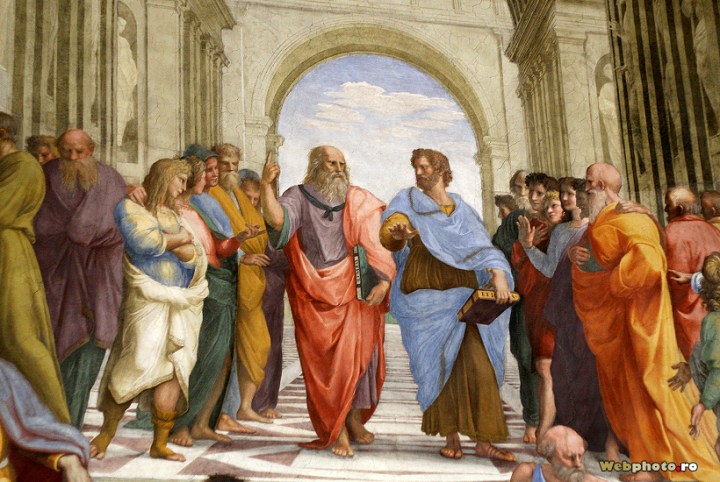
In The Republic, Plato describes the descent of a city from monarchy to tyranny, via timocracy, oligarchy, and democracy.
First impressions might indicate that Plato and Hobbes are describing two completely different scenarios. However, while the latter appears to be describing the birth of a civilised entity from some kind of savage pre-civilisation, there is nothing to say that a state of nature cannot be born from the ashes of a civilised entity. Indeed, many of the 21st century’s approximations to a Hobbesian state of nature exist as the result of civil war and collapse of civilian governments (certain parts of present-day Syria, for example), and it was, after all, in the aftermath of the English Civil War, a war that killed 3.6% of the population (vs 2.1% of the population in WW1 – a staggering statistic), that Leviathan was written. Hobbes’ experience of the failure of the sovereign to save man from himself clearly left its mark.
It is this kind of political collapse that Plato seems to warn against and for him, it is most likely to occur where the polis is destroyed from within by the transformation of the sovereign into a tyrant. As the city’s ability to enforce laws and protect citizens diminishes, reason gives way to self-preservation, and man submits to his formerly checked desires and appetites. The tyrant is no longer interested in the security of others, only in his own preservation. He engages in violence against his own citizens, an event anticipated also by Hobbes. Depending on your view, Leviathan has either forsaken or turned on Plato’s perfect city.
Both Plato and Hobbes warn against the state of nature and the dangers to the welfare of all in the absence of strong government. Interestingly, though, while Hobbes places no blame on mankind for his behaviour in a state of nature – where there is no other guidance on how one should behave, one adapts to survive – Plato believes that the state of nature is the result of the moral failure of men.
Perhaps we really do get the politicians we deserve. Or perhaps we don’t realise how lucky we are.
 Epyllion
You must be logged in to post a comment.