An essay submitted as part of my Classics 2A course at the University of Glasgow, December 2019.
This paper will discuss and compare the roles of the chorus in Aeschylus’ Prometheus Bound and Sophocles’ Antigone. It will focus particularly on themes of gender, and legal and political thought, the latter highly relevant to 5th century, democratic Athenians, and the differing approaches taken by the dramatists in their efforts to generate – not just within the context of the performance as experienced by the audience, but inside the play itself – an “emotive response”[1] to proceedings. While scholarly opinion has historically explored the strong visual impact of the tragic chorus, how it “dominates the tragic spectacle”[2], and noted how it “normally stayed there (on stage) throughout the entire play after the opening scene”[3], Taplin in particular has queried the relevance to plot of much of their output.[4] Vernant, however, claims that the “true material of tragedy is the social thought peculiar to the city-state”[5], and once we enter this realm, the importance of the chorus as a conduit between the message of the play and the audience becomes more transparent. Clearly, different playwrights used the chorus in different ways, and the argument presented here will be that in the two plays being discussed, the extension of “intellectual and normative context”[6] through the chorus is a main goal of the playwrights. That is, contrary to Taplin’s views, in Antigone and Prometheus Bound the choruses play an integral part in both the story and in bringing the audience closer to, and more involved with, the action of the play.
————————————————————————————————————————————–
As the formal policing and organisation of the polis grew throughout the 100-year period of Athenian cultural prominence, so the citizens were confronted with new challenges to their ways of being and thinking. Their responses to these social, legal, and political challenges would require ever-deeper introspection. Tragedy provided a lens which brought these factors sharply into focus, and the chorus played an important role in this. As referenced in the introduction, Taplin claims that despite the “prominent and important place”[7] of the tragic chorus, their performance often exists at a distance from the actual plot of the play. Contrary to this, I believe that in Prometheus Bound (and to a lesser extent, in Antigone), the chorus plays a highly participatory role alongside the tragic hero of the title. There is a high level of direct conversation between both, and this lends itself to a strong identification between chorus and audience. As Munteanu says, as “an internal voice that consistently appeals to the spectators’ pity”[8], the chorus allows the audience to enter the world of the play and experience the conflicting emotions towards a being undergoing a tremendous amount of suffering on the one hand, but, crucially, one who has transgressed the law on the other. Considered within a legal and political framework, the role of the chorus is extremely interesting. They are neither protagonists, at least at first glance, nor judges, but they are inextricably linked to the fate of Prometheus because they choose to position themselves in just that way, eventually, by demanding to share in his fate. Throughout Greek tragedy, the chorus warns, speculates, commentates, and even occasionally expresses its desire to participate in the suffering of the tragic hero [9]. Seldom does it find itself as close and committed to the absolute centre of the action as it does at the end of Prometheus Bound, the direct object of the admonition of Hermes: “blame yourselves, for now you know what you are doing”[10]. A parallel can be drawn here with the participatory element of democracy at Athens, where the citizen body made its decisions on the important matters of the day, and then would have to live with the outcomes. One can well imagine a leading citizen in the assembly acting as Hermes does, attempting to sway decisions in his favour, warning the demos of the consequences of their actions.
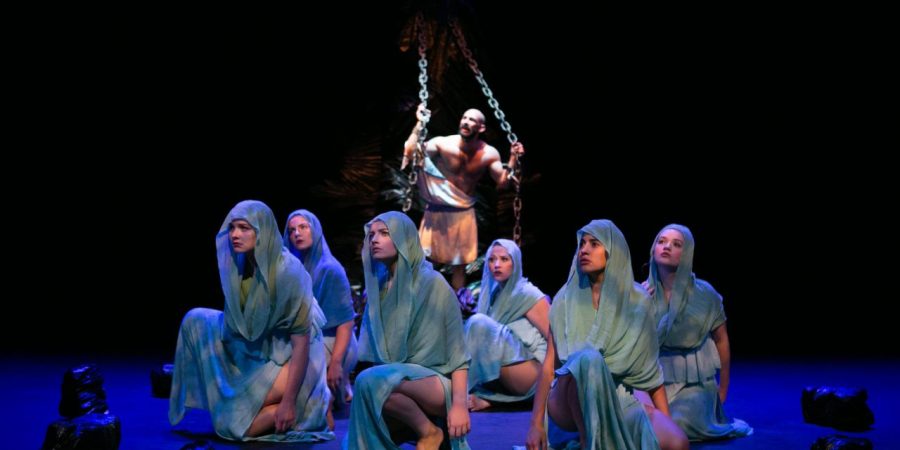
It is perhaps as an allegory on the Athenian’s history with tyranny that we may best interpret the most striking representation of the chorus in Prometheus Bound. There are many lines throughout the play where we see revolutionary language employed in response to the over-zealous actions of Zeus, and I would argue that the early line from Might, “What kind of help can mortals offer to save you from these sufferings?” [11] is a challenge to the audience. What would the audience do if it saw what it perceived to be a miscarriage of justice carried out by a bloodthirsty ruler? To this challenge, the chorus responds by working through four stages of reason. First, the “company of friends”[12] expresses solidarity, before appearing to incite rebellion by questioning whether someone may “take the power from”[13] the architect of “these customs that have no justice to them”[14]. This is a bold, open challenge to the authority of the ruler, one which would be far more alien to states with less democratic freedom than Athens. Next, they proceed to question whether Prometheus may have some responsibility to bear for his current predicament. “You are free of tongue, too free”[15] is the warning of a citizen to a troublemaker, a citizen who, when politics brings such violence to bear on discordant voices, sees clearly the most practical way to ensuring a quiet life. A far-sighted citizen, however, recognises that silence does not resolve the problem of tyranny. “Your misfortunes frighten me”[16] shows that the chorus can extrapolate the fate of many from the fate of one should there be no adequate response from the citizen body. Admonishment returns with the line “Do you not see how you have erred”[17] and we can imagine the chorus/citizen bemoaning his own situation, torn between deciding whether to help, to stand steadfastly alongside in rebellion, or to censure the protagonist for having brought this scenario into existence at all. This is a position we will see paralleled in Antigone. Third, following a short exit which allows the scene with Ocean to take place, the chorus returns bringing news from the wider world. Report of the tyrant’s actions has spread and discord is everywhere; from Asia where “they lament what was magnificent of old”[18] to Arabia where, more importantly, at least from a tyrant’s viewpoint, there are “fighters terrible, crying for battle, brandishing sharp-pointed spears”[19]. As “The wave cries out as it breaks into surf”[20], so public opinion is rising to a crescendo of bitter sorrow and a thirst for revenge, threatening to erupt at any moment. Finally, by way of another barb at Prometheus for failing to take care of himself[21], but reminded of the brutality of Zeus by the fate of Io, the chorus commits itself to the fate of Prometheus. In the face of orders to flee from the god’s messenger, “lest the hard and deafening roar of the thunder destroy your wits”[22] they overcome their earlier indecision and stand by the tyrant’s enemy, completing their journey through the moral maze constructed by the gods. Contrary to Vidal-Naquet’s observation that “the chorus never makes decisions”[23], it is a stunning political move, the likes of which is not found often in Greek tragedy, and to defy Zeus, the tyrant, in such a revolutionary manner, would surely have recalled the Athenians’ own history of standing up to, and overthrowing, unjust rule.
My position on the role of the chorus in Prometheus Bound is that it presents a problem in as much as it, not Prometheus, to a certain extent, becomes what Vernant calls “this being that tragedy describes as a deinon”, “incomprehensible and baffling”[24]. Aeschylus places the chorus, and by extension, the audience, on a tragic path, usually reserved for the main hero, that seems destined to lead them to their doom. Indeed, throughout the play, Prometheus himself displays none of the moral equivocation, the complex psychological dramas of “tragic man”[25]. He appears resolute in his decisions, never swayed to repent, nor to choose a different path, the path so well-trodden by other tragic actors. For him, the cause of his misfortune has already occurred before the start of the play and while he bemoans his punishment, he expresses no regret over his actions. For the chorus, their decision, pondered on throughout, is one of the key themes that is not resolved until the end of the play. Their journey, from cowed observers of brutality, to champions of heroic resistance is, as I believe Aeschylus meant it to be, inspiring.
The role of the chorus in Sophocles’s Antigone, while less central than in Prometheus Bound, is also important to the development of key themes being promoted by the playwright. One example of this, as explored by Lane & Lane[26], is the moral equivocation that a chorus would find itself confronted with as a female character acts against the state. Traditional interpretations of the play portray the struggle between Creon and Antigone as being between the polis and the family. This ignores, however, the difference in context between these two positions as perceived by a male citizen with full political agency, and a female citizen with none. For Antigone, as someone who plays no part in the political processes of the state, someone with no influence over decision-making processes, and someone whose political and legal rights are not equally recognised, the internal struggle of choosing family over city is easily resolved. Not so for the chorus, the male, politically active chorus, who must weigh the claims of both protagonists alongside the future wellbeing of Thebes carefully before choosing a side. Just as Lane & Lane claim of Antigone that,
“the excesses attributable to her must be related to her efforts to overcome
the cultural limitations placed on her because of her womanhood”[27],
the position adopted by the chorus in relation to her acts must be interpreted in light of its “conventional, masculine”[28] bias. Vidal-Naquet develops the space between chorus and Antigone by noting the use of old men to play the part of the chorus, as they were in twenty of the extant tragedies[29]. If women were “beneath the city, relegated to a status of less than citizenship”[30], then the old men were “super-citizens”[31], whose position in society gave them special rights to speak first at assembly and council.[32]
I believe this lack of cultural and political self-awareness on behalf of the chorus is undoubtedly a deliberate piece of social commentary by Sophocles. In tragedy, one question placed in the minds of spectators is “what would I do in this situation?” The playwright is asking his Athenian audience what they would do if they found themselves in the position of the chorus, or, more specifically, the chorus is the playwright’s vehicle to push the citizen body to question its own role and the role of women – or lack thereof – in the Athenian political environment. Evidence of the chorus working through this narrative can be found in various places throughout the play. Its first reaction on witnessing Antigone being brought before Creon is to assume “madness”[33]. This echoes the words of Ismene earlier in the play, where she refers to Antigone’s plan as “wild and futile”[34], and admonishes her with “you go senseless indeed”[35]. That the chorus’s, and, in its defence, Antigone’s own sister’s, first instinct is to blame weakness of the mind rather to consider that she may have reasonable grounds for her actions, is telling. It immediately shows the audience what Sophocles believes their response to “What would I do?”, would be. The dynamic is intriguing, given that the audience, unlike the chorus, has already been provided with Antigone’s own justification in advance of her actions. The possibility of at least some members of the audience feeling slightly put out, shamed perhaps, by Sophocles’ own presentation of them jumping to the conclusion that Antigone is mad, must be considered. If the normative question of tragedy is “what would you do in this situation”, here Sophocles seems to be saying, “This is what you would do. And you know it.”
The next direct reference to Antigone by the chorus demonstrates a nod of appreciation towards her spirit. “The girl is fierce”, and “She cannot yield to trouble”[36] show that the chorus beginning to yield somewhat to reason, reacting to the argument of Antigone, and beginning to reassess its earlier proclamations of insanity. This presents a pivotal moment in the play, as Creon recognises public opinion starting to drift out of his own orbit. He responds defensively – “I am no man and she the man instead if she can have this conquest without pain.”[37] – to the chorus’s shift in sentiment in order to bring them back in line, to keep them on his side, appealing, not for the first time, to the patriarchal norms of the city. Creon utilises two basic arguments to justify his decisions to the chorus and, in lines 639-680, to Haemon. The first is argument is one of male dominance, and the importance of not being seen to be defeated by a woman, as seen in the above quote. The second relates to his power over the city and how the acceptance of Antigone’s “disobedience”[38] would lead to the cataclysmic downfall of the polis. The speech that contains the lines “This ruins cities, this tears down our homes, this breaks the battlefront in panic-rout”, begin with Creon addressing Haemon, but by the later stages of the speech he is addressing the chorus, justifying his right to expect complete subservience regardless of, rather disconcertingly, whether his proclamations be right or wrong (“when it is right, and even when it is not”[39]). The chorus recognises its role as indirect object of this part of the agon, and responds, not too enthusiastically it must be said, in agreement[40]. And while Haemon’s part in the agon seems completely to be directly addressed to his father – his anchor is not power and the state, but to family and love – by this point the chorus is comfortable enough in its new place, a place of judgement that Creon put it in by way of his previous address, to intervene in defence of Antigone. “If your son has spoken to the point you should take his lesson”[41] is another pivotal moment of huge political significance, as the male citizen body intervenes against a tyrant by defending a woman who has disobeyed her ruler’s decree. This contradiction to its previous support of Creon, if it is a contradiction – the chorus also says following Haemon’s speech “Both sides have spoken well”[42] – is a feature peculiar to the tragic chorus. Their number, as noted by Easterling[43], allows them a certain freedom to change their mind should the rhetoric of the main actors be persuasive enough, a characteristic also witnessed in Prometheus Bound, as the chorus swings between criticism of Zeus and Prometheus. It stands in contrast to the often-single-minded tracks taken by the tragic heroes, such as Antigone and Oedipus, as they pursue their goals.
The chorus in Antigone occupies Vernant’s “gap” with Creon’s legal and democratic power on one side, and Antigone’s traditional, religious beliefs on the other[44]. The chorus is caught between the two extremes in a way that a citizen body frequently presented with difficult choices relating to matters of state, foreign policy, and war could relate to. Indeed, viewed in this way, neither Creon nor Antigone are heroes to the extent that their behaviour is to be lauded, but rather, just like Prometheus, they have inadvertently fashioned themselves into “problems rather than models”[45], to be dealt with by the city. Their extreme behaviours force introspection and action, however difficult the circumstances, and to do nothing is not an option.
————————————————————————————————————————————–
This paper concludes, as it must, by rejecting Taplin’s assessment of the chorus as immaterial to plot[46], by asserting that, firstly, in Prometheus Bound, Aeschylus deliberately places the chorus in a central position within the story. Their dilemma over whether to side with the main hero or not is a key thread of the drama, a deliberation played out publicly for Athenian audiences to recognise and empathise with. And secondly, that the chorus in Antigone is used by Sophocles as a fundamental tool to bring the audience into the world of political debate and democratic argument. This chorus is pressured on the one hand by the rhetoric of Creon, their leading citizen, into believing that brutal sentencing and zero tolerance for dissent of the laws of the land are essential to the peace and stability of the polis, and on the other by their own identification and sympathy with Antigone’s loyalty to family. The playwrights’ use of the choruses in these two plays results in a provoking of emotional response, an assessment of political self-identity, and challenges to societal positions on gender and equality. Returning to Vernant’s claim that the “true material of tragedy is the social thought peculiar to the city-state”[47], we find that after all is said and done, it is the members of the chorus, amateur actors chosen from the citizen body itself who, as much as or even more so than the heroes, are central to the message of the performance, who are truly heroic.
Bibliography
Carter, D. M. 2007. The Politics of Greek Tragedy. Bristol Phoenix Press.
Easterling, P. E. 1999. “Form and Performance.” Edited by P. E. Easterling. Greek Tragedy 151-177.
Gagne, Renauld, and Marianne Govers Hopman. 2013. Choral Mediations in Greek Tragedy. Cambridge University Press.
Goldhill, Simon. 1990. Reading Greek Tragedy. Cambridge University Press.
Hesk, Jon. 2007. “The socio-political dimension of ancient tragedy.” Edited by Marianne McDonald and J. Michael Walton. Greek and Roman Theatre (Cambridge University Press) 72-91.
Lane, Warren J, and Anne M Lane. 1986. “The Politics of Antigone.” Edited by J. Peter Euben. Greek Tragedy and Political Theory 162-182.
Lattimore, Richard, and David Grene. 2013. Greek Tragedies 1. University of Chicago Press.
Munteanu, Dana LaCourse. 2011. Tragic Pathos. Cambridge University Press.
Taplin, Oliver. 1978. Greek Tragedy in Action. Methuen & Co.
Vernant, Jean-Pierre, and Pierre Vidal-Naquet. 2006. Myth and Tragedy. Cambridge University Press.
[1] Taplin, 1978: 193
[2] Gagne & Hopman, 2013: 6
[3] Taplin, 1978: 12
[4] Ibid 13
[5] Vernant, 2006: 25
[6] Goldhill, 1990: 271
[7] Taplin 1978: 13
[8] Munteanu, 2011: 168
[9] Ibid
[10] Aeschylus, Prometheus Bound 1076-7
[11] Ibid 83-4
[12] Ibid 128
[13] Ibid 167
[14] Ibid 150
[15] Ibid 180
[16] Aeschylus, Prometheus Bound, 182
[17] Ibid 260
[18] Ibid 409
[19] Ibid 422-4
[20] Ibid 431
[21] Ibid 507-8
[22] Ibid 1061
[23] Vidal-Naquet, 2006: 312
[24] Vernant, 2006: 32
[25] Ibid 31
[26] Lane & Lane, 1986: 162-163
[27] Ibid, 163
[28] Ibid, 165
[29] Vidal-Naquet, 2006: 312
[30] Ibid
[31] Ibid
[32] Ibid
[33] Sophocles, Antigone 384
[34] Ibid 68
[35] Ibid 98-99
[36] Ibid 471-472
[37] Ibid 484-485
[38] Ibid 673
[39] Sophocles, Antigone 668
[40] Ibid 681-682
[41] Ibid 724-725
[42] Ibid 726
[43] Easterling, 1999: 164
[44] Hesk, 2007: 76
[45] Ibid
[46] Taplin, 1978: 13
[47] Vernant, 2006: 25
 Epyllion
You must be logged in to post a comment.